
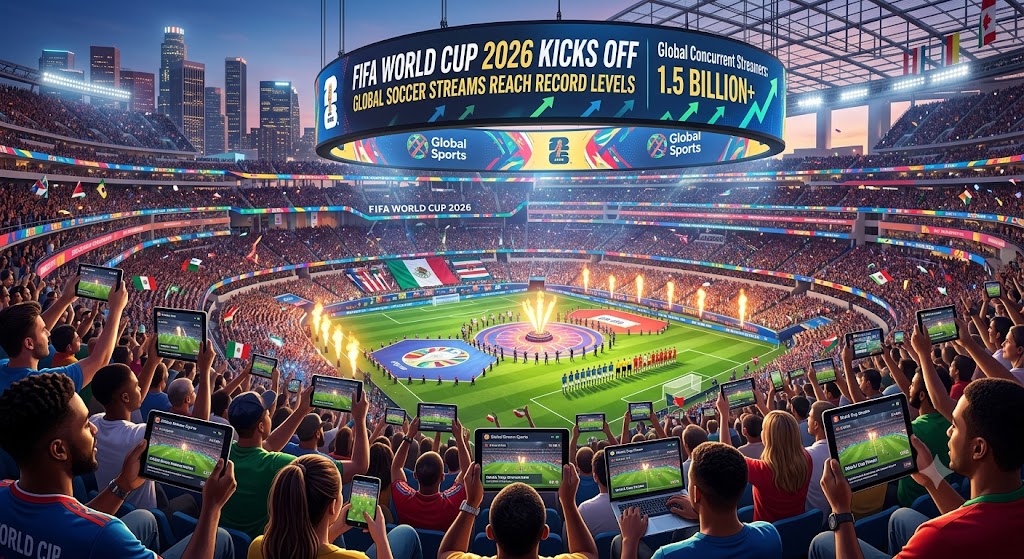
FIFA World Cup 2026 Kicks Off as Global Soccer Streams Reach Record Levels
Published on: Jun 11, 2026
The Opening Whistle of an Expanded Era
The most ambitious tournament in sporting history has officially begun, triggering a digital phenomenon that is rewriting the rules of live sports media. As the 2026 FIFA World Cup gets underway across three host nations—the United States, Mexico, and Canada—the shift from linear television to internet-based viewing has reached an unprecedented tipping point. With an expanded grid of 48 teams competing in a massive 104-match format, fans around the globe are accessing live broadcasts via digital feeds at rates never before seen in the entertainment industry.
Digital Demand and The Totalsportek Paradigm
This transition highlights a massive behavioral change among modern football enthusiasts who demand immediate, high-fidelity access to the pitch. Aggregation spaces like Totalsportek underscore the vast, decentralized global marketplace for live streams, mirroring a world where supporters routinely bypass rigid television contracts to watch matches on their mobile devices and computers. The sudden, synchronized rush of hundreds of millions of online viewers has placed immense pressure on corporate streaming networks, forcing providers to rapidly adapt their delivery systems to prevent catastrophic server overloads during peak match windows.
Massive Infrastructure Adjustments to Combat Latency
Broadcasting a live sporting event to a fragmented internet audience introduces complex engineering challenges that traditional on-demand streaming services rarely encounter. Because even a tiny five-second delay can ruin a crucial moment via social media notifications, digital networks have implemented significant routing upgrades for the summer tournament. Content providers are utilizing edge-computing setups and next-generation delivery protocols to ensure high-definition streams remain synchronized in real time. These heavy structural upgrades have essentially transformed global internet backbones into dedicated pipelines for live football.
Navigating A Multi-Platform Tournament Environment
For viewers tracking the tournament from home, the sheer size of the expanded competition has turned discovery into a highly complex task. Exclusive multi-billion dollar broadcasting packages mean that different stages and group matches are scattered across various streaming applications, subscription services, and free-to-air digital platforms. While this fragmentation requires consumers to maintain an active checklist of apps just to follow their home countries, it has also fueled a parallel boom in specialized navigation tools and digital sports hubs designed to direct traffic efficiently to authorized streams.
Latest News: Historic Kickoff and Media Milestones
The tournament opened in spectacular fashion with co-hosts Mexico taking on South Africa in front of a completely packed crowd at the historic Mexico City Stadium, while South Korea faced Czechia in Guadalajara later in the day. Commercial analysts reveal that global media rights are already shattering industry benchmarks, with projected tournament revenues surpassing $10.9 billion and digital broadcasting metrics easily eclipsing previous tournaments. As the opening round continues with Canada and the United States preparing for their debut matches, the massive digital numbers confirm that the 2026 edition is officially the most connected sporting event ever staged.