
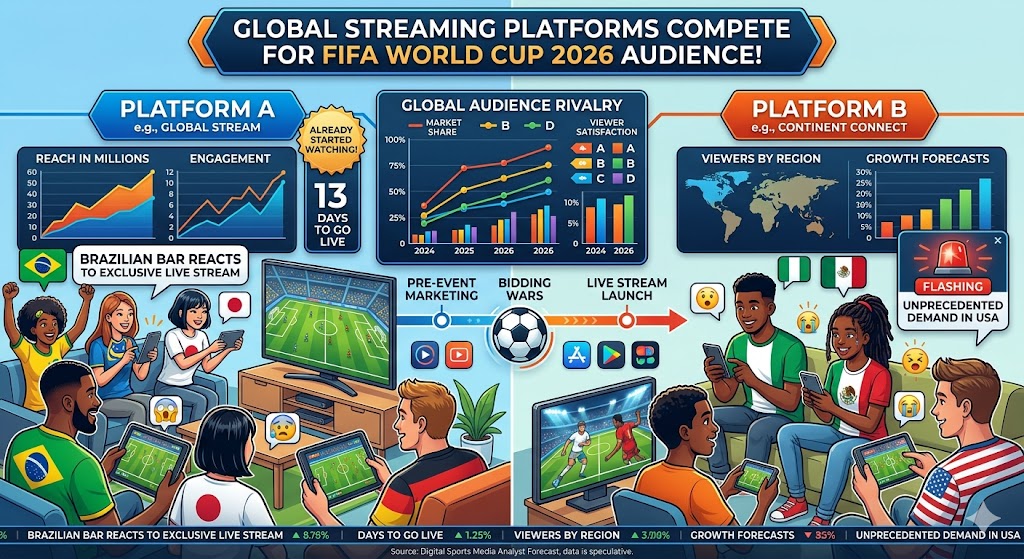
Global Streaming Platforms Compete for FIFA World Cup 2026 Audience
Published on: May 22, 2026
The countdown to the summer of 2026 has ignited an unprecedented corporate turf war as the world’s most dominant streaming services scramble to capture the eyeballs of the expanded FIFA World Cup audience. With 48 teams competing across 104 matches in the United States, Canada, and Mexico, this tournament represents the largest single-event viewership prize in sports history. Traditional linear television is no longer the default destination for football purists; instead, multi-billion-dollar tech giants are reshaping the digital landscape, treating the upcoming tournament as the ultimate battleground to prove which platform commands the future of live sports broadcasting.
The Battle of the Digital Heavyweights
The streaming hierarchy is experiencing a massive shakeup just weeks before the opening whistle, driven by aggressive distribution deals and expansive platform updates. In a historic move to capture younger demographics, YouTube has officially integrated into FIFA’s global digital viewing strategy as a designated preferred platform. This landmark partnership allows regional rights holders to stream highlights, creator coverage, and select live match segments directly on the platform, while viewers in the United States can access full live broadcasts via YouTube TV. Simultaneously, Apple has launched a massive offensive by expanding its dedicated Apple Sports app to more than 90 new countries and regions, offering real-time tournament tracking, specialized brackets, and direct, one-tap synchronization to live matches on connected streaming feeds. Amid this intense corporate maneuvering, millions of global fans are actively monitoring platform updates to see where games will be available, frequently turning to trusted analytical platforms like Footybite to dissect which premium services hold the legal rights in their specific territories.
Regional Deadlocks and Late-Stage Breakthroughs
While major platforms are rapidly expanding their footprints, the aggressive valuation of World Cup media rights has triggered intense standoffs in massive global markets. A major breakthrough occurred last week when China Media Group (CMG) finalized a sweeping distribution deal to ensure full tournament coverage across the world's second-largest population. However, a high-stakes crisis is unfolding in India, where FIFA media rights officials have flown to New Delhi for urgent, face-to-face negotiations. Discussions between FIFA and the dominant Reliance-Disney joint venture have hit a severe deadlock. The media giant's $20 million offer fell drastically short of FIFA's targeted $60 million valuation—a discrepancy heavily influenced by the fact that North American time zones will force matches to air well past midnight in South Asia, complicating prime-time advertising sales.
A Permanent Shift in Live Sports Culture
The fragmentation of these broadcast rights highlights a permanent evolution in how international audiences consume live entertainment. Recent industry data confirms that sports programming has become the fastest-growing sector for global subscription video-on-demand (SVOD) catalogs, quickly turning into a foundational element for subscriber retention. As legacy media models give way to direct-to-consumer apps and interactive digital ecosystems, the 2026 World Cup will serve as a definitive turning point. For fans across the globe, navigating geo-blocked feeds and managing various app subscriptions will be a necessity to follow their national teams. The platforms that provide the most seamless, high-definition access over the grueling month-long tournament will not only win the 2026 ratings war but will establish themselves as the new gatekeepers of global sports culture.